Squandered Opportunity: Neoclassical Realism and Iran's Foreign Policy by Thomas Juneau
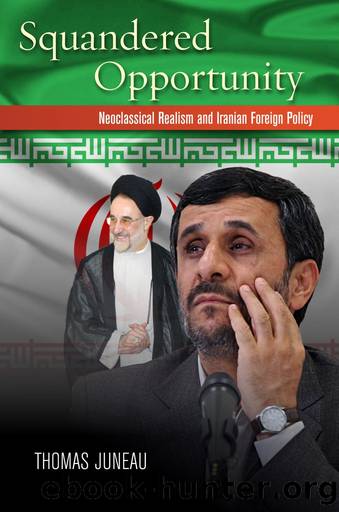
Author:Thomas Juneau [Juneau, Thomas]
Language: eng
Format: epub
Tags: International Relations, Political Science, Diplomacy
ISBN: 9780804795081
Google: P1RzCAAAQBAJ
Publisher: Stanford University Press
Published: 2015-05-19T14:01:15+00:00
7
Iranâs Nuclear Program
In 2002, an Iranian opposition group revealed that Iran was more advanced with its covert nuclear program than had been previously assumed. Since then, Iran and the United States have been engaged in an increasingly tense standoff. The U.S., supported by many in the international community, is suspicious of Iranâs claim that the program is solely for peaceful, electricity-generation purposes. Citing Tehranâs refusal to answer questions about past activities with a weapons dimension, Washington has pushed hard for the international community to adopt an increasingly harsh sanctions regime with the purpose of forcing Iran to compromise. In addition, the United States, along with Israel, has regularly stated that âall options are on the tableâ to resolve the issue, implying that military force could be used as a last resort.
Why is Iran pursuing its nuclear ambitions, despite the tremendous and mounting economic and diplomatic costs it suffers as a result? This case features paradoxical results. Driven by the window of opportunity it faced, Iran chose to incrementally but steadily progress along the nuclear path; this promises important benefits, but also leads to significant consequences.
THE ORIGINS OF THE NUCLEAR PROGRAM
The nuclear program was launched in 1957 with an agreement between Pahlavi Iran and the United States on the peaceful use of nuclear energy. Washingtonâs support arose in a context of growing ties with Tehran, which it viewed as a bulwark against Arab radicalism and Soviet designs in the Middle East. The U.S. initially provided Iran with a 5MW research reactor that became operational in 1967.1 The shah also signed cooperation agreements with other Western countries, allowing Iranian students to attend universities in the United States and Western Europe. Iran also signed the Nuclear Non-Proliferation Treaty (NPT) in 1968 and ratified it in 1970.
The oil shock of 1973 massively increased Tehranâs revenues and boosted the shahâs ambitions, leading him to formally declare his objective to produce nuclear energy for domestic consumption to free up hydrocarbons for export. The shah also announced the creation of the Atomic Energy Organization of Iran (AEOI), while two German companies began but never finished a civilian nuclear power reactor in Bushehr, in southern Iran. The U.S. and Iran signed a $15 billion agreement for the construction of eight reactors in 1975 and the U.S.-Iran Nuclear Energy Agreement in 1978. The United States also granted Iran most-favored nation status for spent fuel reprocessing that year.
The shahâs intentions were unclear. He never stated that he was seeking nuclear weapons, and in any case by the 1979 revolution he remained far from building one. Yet some suspected him of using the cover of a peaceful program to hide his pursuit of weapons. For proponents of this view, such an ambition would have been consistent with his growing regional aspirations (Entessar, 2009, pp. 26â28). Others have argued that his intention was to reach a latent capability. His foreign minister, Ardeshir Zahedi, for example, claimed in 2004 that the shahâs strategy was âaimed at creating what is known as surge capacity,
Download
This site does not store any files on its server. We only index and link to content provided by other sites. Please contact the content providers to delete copyright contents if any and email us, we'll remove relevant links or contents immediately.
| Anthropology | Archaeology |
| Philosophy | Politics & Government |
| Social Sciences | Sociology |
| Women's Studies |
Born to Run: by Christopher McDougall(7127)
The Leavers by Lisa Ko(6948)
iGen by Jean M. Twenge(5416)
Sapiens by Yuval Noah Harari(5371)
Spare by Prince Harry The Duke of Sussex(5197)
The Kite Runner by Khaled Hosseini(5179)
Machine Learning at Scale with H2O by Gregory Keys | David Whiting(4313)
Bullshit Jobs by David Graeber(4190)
Never by Ken Follett(3957)
Goodbye Paradise(3810)
Livewired by David Eagleman(3775)
Fairy Tale by Stephen King(3399)
A Dictionary of Sociology by Unknown(3085)
Harry Potter 4 - Harry Potter and The Goblet of Fire by J.K.Rowling(3074)
The Social Psychology of Inequality by Unknown(3031)
The Club by A.L. Brooks(2925)
Will by Will Smith(2920)
0041152001443424520 .pdf by Unknown(2846)
People of the Earth: An Introduction to World Prehistory by Dr. Brian Fagan & Nadia Durrani(2738)
